The Bleacher Cup HolderBy Steadi Labs

A base for the plank

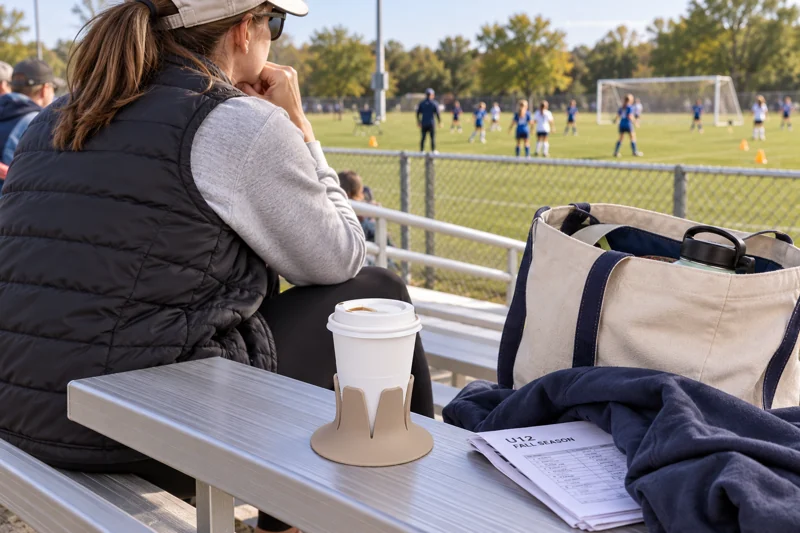
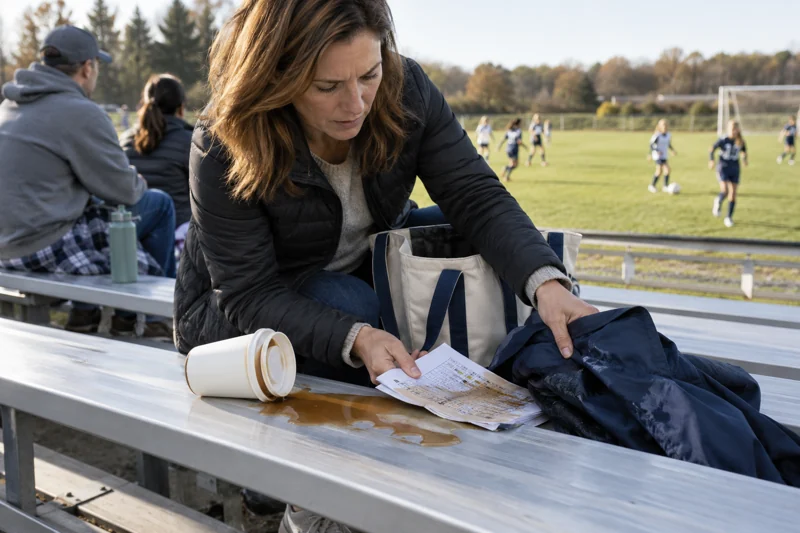
A bench has nothing to bolt a cup holder to.

Pull the catalogue of a company that supplies stadium cup holders to professional, college and high school venues and the whole menu is rail mounts, fence mounts, wall mounts, seat-back and suite-seat mounts, and vertical baluster mounts. Every one of them hangs a cup off something upright.

Between your hip and the row in front of you there is nothing upright. That is not an oversight in bleacher design — that is what a bleacher is. So the fix has to arrive from the seat side, in the tote, with you.

4.9 average · 120 reviews

See the packs

from $14.95 · free shipping on every order

Ships from Orange, California. 90 days to change your mind, used is fine.

A sage Steadi holding a tall can on a scuffed aluminum bleacher plank, with empty rows and other spectators behind it.
Outfield sage, on the plank. Twelve colours in all.

Read this before anything else

The Dodgers solved this. Your kid’s school never will, and it is not the money.

Spectator Sports Inc. describes itself as a leading supplier of stadium cup holders at the professional, college and high school levels, and names the Cubs, the Dodgers, the Durham Bulls, Kinnick Stadium and the Wisconsin Badgers among its venues. Looked up 2 September 2026. Here is how its products mount — all of them.

Rail mount

Needs a rail

at seat height

On an open bleacher the guardrail is behind the top row and around the open ends. There is none between you and the row in front.

Fence or wall mount

Needs a wall

or chain link

Real, and genuinely available — along the fence line at the bottom of the stands. Twelve rows from where you are sitting.

Seat-back mount

Needs a back

on the seat ahead

A chairback seat gives you a free structural surface at cup height, already engineered to hold a person. That is the whole trick, and a bench gives you the back of nobody.

Or on the plank

$14.95

needs nothing

A 5.2″ moulded base, about 3.6 ounces, that the drink stands in. It does not hang off anything, because there is nothing at seat height to hang off.

Here is the tell that this is geometry and not budget. Buy an outfield bleacher ticket at Wrigley Field and what you get is general admission, bench-style seating with no backs — and therefore no cup holder, in the middle of a major league ballpark, in the most famous bleacher section in America. The tier that goes without is not defined by wealth. It is defined by seat type.

Sources: stadiumcupholders.com (Spectator Sports Inc.) · rateyourseats.com (Wrigley Field bleachers). Both fetched 2 September 2026 and quoted as published.


What a bench actually is

Beside your hip and the path everybody walks are the same square inches.

  • A bleacher is not furniture. It is a length of aluminum, divided.

    Under ICC 300 — the standard on bleachers, folding and telescopic seating and grandstands — bench capacity is calculated at “one person for each 18 inches of length of the bench” (ICC 300-2017, Sec. 403.1). Buy thirty feet of plank, get twenty spectators on paper.

  • Nine inches deep, twenty-two inches apart

    Bleacher seats are a minimum 9 inches deep with row-to-row spacing of at least 22 inches (Sec. 407.1). Take a common 2x10 seat plank out of 22 inches and what is left is roughly twelve or thirteen inches of walkway.

  • And that walkway is already spoken for

    The aisle accessway — the path everybody sidesteps along to reach the middle — has a minimum clear width of 12 inches (Sec. 407.2), which grows by 0.3 inch per additional seat on a row served at both ends and 0.6 inch on a row served from one end, up to 22 inches (Secs. 407.3 and 407.4). Whatever margin a real installation has is an inch or two, and the standard has already spoken for it.

  • The gap under your feet is usually legal, not broken

    The CPSC recommends no opening large enough to pass a 4-inch sphere, and says plainly what that number is calibrated to: anthropometric data showing 95% of children four months and older would be stopped by a 4-inch opening. It is a child-body threshold, not a dropped-object one. And when a jurisdiction adopts a new code, existing bleachers typically are not required to comply.

Sources: International Code Council, ICC 300-2017, via up.codes · U.S. Consumer Product Safety Commission, “Guidelines for Retrofitting Bleachers,” Pub. No. 330 (cpsc.gov). Both fetched 2 September 2026. CPSC says of that document that it issued the guidelines as recommendations, not as a standard or mandatory requirement.

The row above on an aluminum grandstand: sneakers on the footboard, the flat seat plank, and the open gap between footboard and seatboard.
The row above, the footboard, the gap. Nothing at seat height to grab.

Does it actually work

It wobbles. Then it settles.

A weight lands beside it, the surface moves, and the drink comes back level. The base is 5.2 inches across and spreads the load instead of balancing on a point.

Straight about this one: it was filmed on a couch cushion, not on a bleacher plank. That is the footage we have. Aluminum is harder and slicker than what you are watching, so read this as the mechanism rather than as your Saturday — and read the limits further down before you decide.

A full can standing in a white Steadi on a couch cushion, a living room behind it.
Real footage, one take, no cuts. Filmed indoors, on a cushion.

How it holds

Width, and nothing else.

The base

5.2 inches across and fixed. It widens the base of support under the cup, so the drink’s centre of mass has to travel much further sideways before it clears the edge. Tipping takes a far bigger lean than it would on a bare cup bottom.

The fins

Six of them, from 0.92 inches up and flexing to 3.15, holding the bottom inch. Cans and bottles slide on over the top; tumblers and glasses drop in through the fins. Drink and base then move as one piece.

The plank

A seat plank is smooth mill-finish aluminum, warm in the sun, and often set with a slight slope back. The tack of the TPU is what resists a sweating cup sliding on a surface like that — the other half of what a bench does to a drink.

A macro photograph of the flared base of a Steadi, showing the moulded STEADI mark.
The flare, close. That width is the entire mechanism.

See the packs — from $14.95

The object

One piece of rubber, and nowhere to put hardware anyway.

There is no clamp, no strap, no hook, no bracket and no suction cup. On a bleacher that is the design rather than a shortcoming: a seat plank is a wide flat box extrusion with nothing at seat height for a jaw to bite. It goes on the plank and the drink goes in it. When the game ends you pick it up and the bench is a bench again.

  • Base5.2″ — fixed
  • Height2.8″
  • Opening at rest1.64″
  • Weightabout 3.6 oz
  • Fins6, from 0.92″ up, flexing to 3.15″
  • MaterialShore 85A TPU
  • Rail requiredNone — there isn’t one
  • HardwareNone
  • CleaningHose it off, or dishwasher
A hand sliding a can down over the fins of a Steadi from above.
Cans and bottles go on over the top. Tumblers drop in.

What seats and what does not

The 40 oz Stanley first, because that is the question.

A Stanley Quencher H2.0 40 oz measures about 3.1 inches across the bottom. The fins flex to 3.15, so it seats snug — it goes in with a push and holds. The handle is up at the lid, well clear of the fins, which is why a Quencher works and a coffee mug does not. A standard 12 oz can is 2.6 inches across the bottom and slides on over the top. A handled mug is a straight no, and so is a stemmed glass: the handle and the stem land exactly where the fins grip.

Search by container

Every width below comes from a published specification, not from us. Where a spec is uncertain, the answer says so.

Or the width across the bottom

A width across the bottom of the cup, in inches.

Six Steadis in a row on a kitchen counter, each holding a different can.
Six on the counter. Bases between two and three inches all seat.

Do it tonight, while you pack the tote

A standard sticky note is three inches square. Stand your tumbler on one at the kitchen counter: base inside the paper and it seats, overhanging a little and it is the snug end of the range.

Anything borderline — hello@steadilabs.com reaches a person, and the answer will be honest either way, including a no.

Where they end up

The plank beside your hip. The footboard. The concrete by the fence.

Those three, mostly, and in that order. The seat plank if the row is not full, the footboard between your feet if it is, and the concrete apron at the bottom of the stands if you have given up on the steps and moved down to the fence. The cooler lid works, the wagon lid works, and the folding table outside the snack shack works, because all of them are flat and none of them is a rail.

Twelve colours, and the picker assigns one per unit — which is the fastest way anybody has found to stop three families arguing about whose drink is whose halfway through game two.


What a cup holder on that bench would cost

Every real answer is a construction project.

These are not the same purchase — a grandstand is capital and this is an object — and that is precisely the point. Every figure below is the publisher’s own, looked up on 2 September 2026, with the publisher named in the row.

The fixWhat it costsWhat it asks of the bench
Rail, fence, wall or baluster mounted stadium holder (Spectator Sports Inc., stadiumcupholders.com)Quoted per jobSomething upright to hang from. That catalogue is the industry’s whole answer, and it has no bench product, because you cannot invent a vertical member that is not there.
Individual seats, which can be specified with holders (Preferred Seating; National Recreation Systems)past $1,000 a seatReplacing the seating. Preferred Seating says schools choose aluminum benches for maximum capacity, low cost and basic functionality; National Recreation Systems puts VIP seating with armrests past $1,000 a seat in larger installations.
The aluminum bench you already have (National Recreation Systems, bleachers.net)$100–$500 a seatNothing, and it gives nothing back. Capacity is arithmetic: one person per 18 inches of bench length under ICC 300-2017.
A new seating bowl with “cupholders throughout” (Toronto Blue Jays, Rogers Centre)nearly $400M CADGutting the stadium to the concrete. The published list of what that bought includes “fewer seats in each row” — every comfort feature is paid for in capacity, which is the one thing a district is actually buying.
The Bleacher Cup Holder$14.95 · four for $39.95, $9.99 eachNothing. A flat plank is enough, and it leaves with you. No permit, no drawings, no facilities request, no bond.

Nobody has ever gotten a line item approved for somewhere to set a coffee. The money that touches bleachers is compliance money — guardrail retrofits, infill panels, the quarterly walk-through, the biennial fit-for-use letter from an engineer. When capital does arrive it arrives on a bond ballot, the way Portland Public Schools’ bond page lists “upgraded bleachers” beside turf, lighting and track reconstruction, and it replaces the whole structure once a generation.

If your stands do have a front rail, a top-row guardrail or a chain-link fence line, a row of rail-mounted holders is a real, existing, purchasable product and the FAQ below says how to ask for it. That request has somewhere to go. A request for holders on the benches does not.

Sources: stadiumcupholders.com · preferred-seating.com · bleachers.net (National Recreation Systems) · newswire.ca (Toronto Blue Jays announcement) · bond.pps.net · up.codes (ICC 300-2017) · cpsc.gov (Pub. No. 330). All fetched 2 September 2026 and current as of that date.

Get one

How many drinks go up the steps with you.

Count the people in your row who carry a drink, not the people on the roster. For most families that is two or four. Free shipping on all of them, and at 2.8 inches tall they go in the tote you are already hauling rather than on top of the wagon.

Checkout is handled by Steadi Labs — the company that makes The Bleacher Cup Holder. Secure checkout at steadilabs.com. Free shipping on every order, and 90 days to change your mind, used is fine.

From people who bought one

One of these is from a metal bench. None of them is from a ballfield.

Verbatim, unedited, and not filtered by rating — the four-star is here on purpose. Steadi Labs sells one product, and every review in the corpus is a review of that product rather than of this page. Nobody has yet written in from a travel-ball Saturday. The nearest thing that exists is a grandstand at a NASCAR race, and it is the first card below because it is the closest anyone has come to your bench.

A black Steadi on a grandstand bench holding a canned drink in a glitter koozie, a spectator's leg beside it, at an outdoor race
Photograph sent in by Holly J with this review.

★★★★★

Steadi- Just what I was looking for! I purchased these to use at our annual NASCAR race this month. They delivered beyond my expectations. Our seats are metal benches with a slight slope towards the back, making it impossible to set down any type of drink. We were able to use these for a 20oz bottle with a koozie on it as well as a slim can with an insulated Brumate on it! They worked perfect, holding our drinks on the bench & on our cooler. I highly recommend for sporting fans, boaters, outdoor adventures. Thanks for making these!

Holly J · June 2026Photo from the buyerPhoto from the buyerPhoto from the buyerPhoto from the buyerPhoto from the buyerPhoto from the buyerPhoto from the buyerPhoto from the buyer

A white Stanley insulated tumbler seated in a black drink base standing on an open spiral planner covered in handwritten to-do notes, with a basket of pens alongside
Photograph sent in by Connie Waters with this review.

★★★★★

Excellent
Fits my small Stanley water bottle perfectly.
Highly recommended

Connie Waters · June 2026Photo from the buyerPhoto from the buyerPhoto from the buyerPhoto from the buyerPhoto from the buyerPhoto from the buyerPhoto from the buyerPhoto from the buyer

★★★★★

They are great! They work very well in keeping the soda cans from falling over and spilling on the bed & couch when the three Beagles and one Border Collie jump on or off. They also stay steady on the little wobbly patio table outside.

Susan Ilkenhans · May 2026

★★★★☆

Seems to work okay I though the base would be heavier

Elisa Hollers · May 2026

17 more, photographed by the people who bought them

Sent in with their reviews. Tap any one to read it. Different rooms, different drinks, different colours — none of them staged by us.

A slice of one product-wide corpus — reviews of the Steadi, not of this page. The full corpus is published live. On the four-star: she is right that it is light. It is about 3.6 ounces and it was never meant to be a weight — the 5.2-inch foot is what does the work, not the mass.


The limits, in one place

What it does not do.

If it turns out to be the wrong thing

Ninety days. Used is fine. Nothing goes back in a box.

That is most of a season. Take them to every Saturday of it, hose them off in the driveway between tournaments, and if the answer is no, hello@steadilabs.com reaches a person and the money comes back — no form, no restocking fee, no questions about condition, and nothing to pack up or post.

  1. You order. Free shipping, every order, always.
  2. It leaves Orange, California within one business day.
  3. USPS, 2–5 days, tracked.

Who makes it

Steadi Labs. One person, in Orange, California.

The steel injection mould open in the machine, the cavity that forms the base visible.
The mould, in the machine.
Scott Rodriguez at a workbench, holding a Steadi and looking at it, with shipping boxes behind him.
Scott, who makes them.

Scott Rodriguez made the first one after a full drink went over on a soft cushion with three kids under three in the house. It was not designed on a bleacher. It was designed on furniture — and then it turned out that what a bench takes away is the same thing a cushion never had, which is an edge to set a drink on.

We make one thing and we make all of it here — the moulds, the material, the colour runs, everything within about three and a half miles of the shop. If you write in, one of us reads it; that is closer to a team group chat than to a call centre, which is either reassuring or not depending on what you are used to.

  • Steadi Labs — veteran founded and veteran owned
  • Designed, injection moulded, picked, packed and shipped in Orange, California
  • Patent pending
  • 100% BPA free
  • 5.2 inches across the foot, about 3.6 ounces

— Scott, Steadi Labs


Questions

Straight answers.

Will my 40 oz Stanley actually fit?

Yes, snug. The Quencher H2.0 40 oz is about 3.1 inches across the bottom and the fins flex to 3.15, so it seats with a push rather than dropping in. The handle sits up at the lid, clear of the fins, which is exactly why a Quencher works and a coffee mug does not. Check yours on a three-inch sticky note before you order.

Does it clamp to the bench?

No, and there is nothing on a bench to clamp to. A seat plank is a wide flat box of aluminum with no rail at seat height for a jaw to bite — that is the same wall the professional manufacturers hit. It stands on the plank and lifts off when you leave.

Will it hold when the whole row stands up for the play?

Honest answer: it resists tipping, it is not fastened to anything, and a sneaker that catches it wins. What the 5.2-inch base changes is how far the drink has to lean before it goes over, and how much a slick sweating cup slides on smooth aluminum. What it does not change is being kicked.

My stadium seat already has a cup holder.

It does, and that seat is worth owning for the back support. But its holder hangs off the chair frame, and the chair frame is the most mobile object on the bench — it slides on smooth aluminum and shifts every time you lean forward. This sits on the plank itself rather than riding the chair, and it also works on the footboard, where the chair never goes.

Will it fall through the gap?

The foot is 5.2 inches across, which is wider than the 4-inch opening the CPSC guidance is written around. But it is not a bridge: it needs a plank under it, not a void. Put it where the metal is.

Can we just ask the school to install some?

You can ask, but ask for the right thing. Do not ask for holders on the benches — you now know the answer and why. Ask about the vertical members the structure already has: the front rail on an elevated bleacher, the guardrail behind the top row, a cross-aisle or press-box rail, the chain link along the field. Those are exactly the mounts the professional supplier sells. It is not automatically simple — anything hung on a guardrail is a loading question, and the CPSC warns specifically that guardrails not designed for people sitting and leaning on them can fail — so it starts with the athletic director and the district’s facilities contact, not a group-chat vote. But that request has somewhere to go.

Does it pack flat?

It is 2.8 inches tall and about 3.6 ounces, so it rides in the tote with the blanket rather than on top of the wagon. It is one solid piece, so there is no folding arm to work loose, no fabric sleeve to fray and no hinge to snap.

Can I put it in the dishwasher?

Yes. Shore 85A TPU, 100% BPA free. Realistically it gets hosed off in the driveway with the cleats, and that is fine too.

Why does this site only sell one thing?

Because it is one thing. It is a Steadi, made by Steadi Labs in Orange, California, and checkout finishes at steadilabs.com where the company lives.

Still deciding

$14.95 for a piece of rubber.

It is. Set it next to a gate fee, a tank of gas and a hotel night and it disappears, but that is your arithmetic to do, not ours — and we are not claiming to be the cheapest thing you could buy, because we have not priced everything you could buy. Ninety days covers being wrong about it, used, with nothing to post back.

I have bought enough things off a feed that broke.

Fair. This is one piece of injection-moulded TPU with nothing to work loose, and it is made in Orange, California by the people who answer the email. Ninety days is the part that should matter to you, not the promise.

Do I actually need this, or am I just used to the floor?

You are used to the floor. Six seasons of putting the coffee on the footboard is not a preference, it is what happens when nobody ever offers you anything else — the structure has no answer, so you stopped asking it for one. This is not a crisis being fixed. It is the drink getting its own seat.

The bleachers at our field are ancient.

Then the gaps are probably wider, because existing bleachers usually are not required to comply when a new code is adopted. Which changes where you set it — on the metal, not over the opening — and does not change whether it works there.

The bench was engineered to hold up a crowd, not a cup.

That is not going to change, this year or after the next bond passes. You just do not have to keep putting the coffee on the floor.

See the packs — from $14.95

Free shipping on every order · 90-day guarantee, used is fine · Made in Orange, California