Every order ships free · 90 days to change your mind · Made in Orange, California
The Bleacher Cup Holder.com ← back to the bleacher page

The bleacher guides

Why the Ballpark Has Cup Holders and Your Kid's Bleachers Never Will

Pro stadiums bolt in cup holders by the thousand. School bleachers get none. The reason isn't money - it's that a bench has nothing to bolt one to.

15 min read · 12 sources

Why the Ballpark Has Cup Holders and Your Kid's Bleachers Never Will

It is 7:55 on a Saturday morning, game one of three, and your coffee is on the footboard between your feet because that is where coffee goes. You have done this for six seasons. Somewhere in the back of your head, usually around the time somebody's sneaker finds the cup, there is a small reasonable question:

The Dodgers figured this out. Why hasn't the school?

It is a fair question and it has a real answer, and the answer is not "because school districts are cheap." I went looking for it in building standards, federal safety guidance, a school purchasing co-op's bid documents and a stadium cup-holder manufacturer's product catalog, and the answer turns out to be more interesting — and more permanent — than a budget line. Nobody is going to bolt cup holders to the bench at your field. Not this year, not after the next bond passes. Here is why, and here is what that means for the two hours you're actually going to spend up there today.

Every stadium cup holder in America needs something vertical

Start with the thing itself. Pull up the catalog of a company that actually makes the cup holders you see in professional ballparks — Spectator Sports Inc., which describes itself as "a leading supplier of stadium cup holders for sports stadiums on the professional, college and high school levels," and names the Cubs, the Dodgers, the Durham Bulls, Kinnick Stadium and the Wisconsin Badgers among its venues. Look at how the products mount.

Rail mounts. Fence mounts. Wall mounts. Seat-back and suite-seat mounts. Vertical baluster mounts, for the gap between railings.

That is the entire menu, and every single item on it is a way of hanging a cup off something upright. The industry has no bench product because the industry cannot invent a vertical member that isn't there. A chairback seat solves the problem by giving you the back of the seat in front of you — a free structural surface at exactly cup height, already engineered to hold a person's weight, already bolted down. That's the whole trick. Every cup holder in a professional stadium is parasitic on a seat back or a rail.

A bench gives you the back of nobody. There is no rail at seat level on an open bleacher; the guardrail, where it exists, is behind the top row and around the open ends. Between your hip and the row in front of you there is nothing but air and a step down. That is not an oversight in bleacher design. That is what a bleacher is.

Even in the majors, the bleachers are the section that doesn't get them

Here's the tell that this is about geometry rather than money. Go to Wrigley Field — a ballpark that has had a decade of nine-figure renovation attention — and buy an outfield bleacher ticket. What you get is general admission, bench-style seating with no backs. No seat back means no cup holder, in the middle of a major league ballpark, in the most famous bleacher section in America.

The tier that goes without isn't defined by wealth. It's defined by seat type. Benches don't get cup holders anywhere on earth, including in front of the ivy.

And when the pros do add them, look at what it takes. The Blue Jays put cup holders into the 100 Level at Rogers Centre as part of a "multi-year, nearly $400 million CAD, privately funded renovation" — a project that demolished and excavated the original seating bowl. The announcement to fans, when the holders finally appeared in 2024, was three words long: You asked for it. A team had to gut a stadium down to the concrete to give the main bowl somewhere to put a beer.

That's the scale of intervention. Cup holders don't get retrofitted onto seating. They arrive with new seating, and seating gets replaced roughly once a generation.

A bench is a capacity machine, and cup holders cost capacity

The reason schools buy benches instead of seats is not really comfort-versus-cost. It's arithmetic.

Under ICC 300 — the ICC standard on bleachers, folding and telescopic seating, and grandstands, which governs where a jurisdiction's building code adopts it by reference — bench capacity is calculated at "one person for each 18 inches of length of the bench" (ICC 300-2017, Section 403.1; the current edition is ICC 300-2023, referenced by the 2024 I-Codes). That's it. A bleacher isn't furniture with a certain number of seats in it — it's a length of aluminum that the code converts into an occupancy number by division. Buy thirty feet of plank, get twenty spectators, on paper.

Individual seats break that math in your favor as a fan and against you as a purchaser. Look at what the Rogers Centre renovation actually delivered alongside the cupholders: "additional legroom, cupholders throughout, modern-shaped seats with more airflow, fewer seats in each row, wider seats and new cross-aisles."

Fewer seats in each row. Every comfort feature in that list is paid for in capacity. A district sizing a grandstand for homecoming, graduation and the one playoff run in a decade is buying the number, not the experience. Aluminum bench runs roughly $100 to $500 a seat; full seats with armrests can run past $1,000 a seat in larger installations. When the goal is maximum capacity at minimum cost, benches win, and the bench comes with what benches come with — which is nothing.

The bleacher budget is already spoken for

There's a second reason the amenity conversation never happens: the money that touches bleachers is compliance money.

The U.S. Consumer Product Safety Commission published its Guidelines for Retrofitting Bleachers after a 1999 roundtable convened in response to two children being fatally injured and five severely injured in falls from bleachers in 1998 and 1999. In the data behind that guidance, bleacher-associated injuries treated in emergency rooms averaged 19,100 a year from 1991 through 1999. The guidance that came out of it is about guardrails and openings: rails at least 42 inches above the leading edge of the footboard, seatboard or aisle, wherever any of those sit 30 inches or more above the ground; no opening in or under a guardrail big enough to pass a 4-inch sphere; rigid infill, not chain link, to close the gaps between seating components.

One thing to be precise about: CPSC says of that document that it "issued these guidelines as recommendations; they are not intended as a CPSC standard or mandatory requirement." What gives them force is the building code a district actually sits under, plus the insurers and state facilities offices that point at them.

Then the inspection cycle on top: CPSC recommends bleachers be "thoroughly inspected at least quarterly" — noting the frequency should depend on how much they are used — and that a licensed professional engineer, registered architect or qualified bleacher firm inspect them at least every two years and provide written certification that they are fit for use. Where a jurisdiction has adopted NFPA 101, a version of that cycle stops being a recommendation: it is required, and it applies to existing installations, not only new ones.

So the athletic director's bleacher file is guardrail retrofits, aisle and handrail additions, infill panels, quarterly walk-throughs and a biennial fit-for-use letter. And when actual capital shows up, it shows up on a bond ballot — Portland Public Schools' bond page, for instance, lists "upgraded bleachers" for a high school baseball and softball field alongside turf, lighting and track reconstruction. That is the cycle: a bond every decade or two, replacing a whole structure.

Nobody has ever gotten a line item approved for somewhere to set a Stanley.

And the school genuinely can't just bolt some on

Suppose your booster club offered to buy them anyway. Two hard walls.

The first is the walkway. ICC 300-2017 requires bleacher-type seats to be a minimum of 9 inches deep with row-to-row spacing of at least 22 inches (Section 407.1), and it sets a floor of 12 inches of clear width for the aisle accessway — the path between rows that everybody sidesteps along to reach the middle — measured as the clear horizontal distance from the back of the row ahead to the nearest projection of the row behind (Section 407.2).

That 12 inches is a floor, not the answer. For longer rows the standard requires the width to grow: 0.3 inch per additional seat where a row is served by aisles at both ends, 0.6 inch where it is served from one end only, up to 22 inches (Sections 407.3 and 407.4). A long bench row at a high school field sits squarely in the range where more than 12 inches is required.

Now do the subtraction. Row-to-row spacing at the 22-inch minimum, less a common 2x10 seat plank, leaves roughly 12 to 13 inches — at or barely above the smallest clear width the accessway is ever permitted, and under what a long row is required to have. Whatever margin a real installation has is an inch or two, and it is margin the standard has already spoken for.

This is the part most people never think about. On a bench, "beside your hip" and the path everybody walks are the same square inches. That is why the drink ends up between your feet in the first place. Anything mounted permanently at seat level projects into that space and eats clear width the standard requires be kept clear — and separately, for aisles proper, ICC 300 states flatly that "there shall be no obstructions in the required width of aisles except for handrails" (Section 404.5.1). The standard never mentions cup holders. It doesn't have to. It governs the inches one would sit in.

The second is that bolting anything to a bleacher gets handled as an alteration to the structure. CPSC is blunt about retrofit risk: materials and methods "should prevent the introduction of new hazards," including possible tipover or collapse "due to improper structural loading of the retrofit hardware onto the bleachers," and retrofits "should not introduce contact or tripping hazards" such as protruding bolt ends. And then the line that shapes the conversation in any facilities office: prior to implementing any retrofit, CPSC recommends consulting the local building official to determine whether a permit is required, because "many jurisdictions require that the applicant obtain the services of a licensed design professional and submit engineering drawings before a permit will be issued."

Whether it actually goes that far is the building official's call, not the booster club's. But that is the door the request has to walk through, and nobody opens it for a cup holder.

Indoors it's even more absolute. Pull a school district's actual purchasing spec for telescoping gym seats — Bid #22-374 from the Washington state purchasing co-op KCDA is public — and read what it demands: center handrails that must "not exceed the front edge of bleacher when stored," a hinged first aisle step that "must be stored within the closed bleacher," 18-inch seat modules, a 10-inch seat surface, parallel and perpendicular sway loads, ADA seating, UL listing, epoxy powder paint. Pages of it. Nothing anywhere in it about a place to put a drink — and structurally there couldn't be, because every row of a telescopic bleacher has to nest inside the row behind it when the gym floor gets cleared for practice. A permanent protrusion at seat level would be destroyed the first time the bleachers folded.

The gap under your feet isn't a defect, it's an exemption

Now the part that reframes the whole thing.

You have watched something go through the bleachers. Everyone who has sat in the stands for more than a season has watched a bottle, a phone or a set of keys drop clean through into the dirt underneath, where it stays until somebody with a gate key does a walkthrough.

That gap usually isn't a broken bleacher. It's an old one — and old is mostly legal.

The CPSC opening recommendation is a 4-inch sphere, and the rationale section says exactly what that number is calibrated to: "anthropometric data showing that 95% of all children 4 months of age and older would be prevented from completely passing through a 4-inch opening." It is a child-body threshold, not a dropped-object one. It also applies only where the footboard is 30 inches or more above the ground and the opening would permit a fall of 30 inches or more, which means the bottom rows of a low bleacher aren't covered by it at all.

Two things follow, and they are worth keeping apart. A bleacher built to current code shouldn't drop your coffee through: the model codes CPSC summarizes cap the horizontal gap between footboards and seatboards at a quarter inch projected on a horizontal plane, which closes the straight-down path even where the vertical opening is generous. The stands at your field are a different question. CPSC gives the reason they look the way they do: when a jurisdiction adopts a new building code, existing bleachers typically aren't required to comply, "because most codes do not have provisions for existing structures that would enable the code to be applied retroactively" — with NFPA 101 the exception CPSC flags in a footnote, because it does carry provisions for existing bleachers. What that leaves underfoot varies enormously from one set of stands to the next; the fatal 1999 case behind the guidance involved a 13-inch opening between a footboard and a seatboard.

So the honest version is narrower than the folklore, and still bleak enough. None of these numbers were set with a drink in mind. The rules that made the bleachers safe for your six-year-old were never asked to make them safe for your coffee — and on an older set of stands, whatever gap is there is a gap nobody is required to come back and close.

The structure is doing its job. The job just isn't the one you needed.

So the fix has to come from the seat side

Once you accept that the structure will never provide, the question narrows usefully: what can a parent carry up five rows that works on a plank with no rail, no back and no attachment point?

Here's the honest ranking of what people actually try.

The hook-over stadium seat. Genuinely worth owning — for the back support, which is the real complaint. But its cup holder is a shallow fabric or mesh sleeve sized for a can, hung off the side of a chair frame, and that frame is the single most mobile object on the bench. It slides on smooth aluminum and shifts every time you lean forward for a play. You've mounted your drink to the thing that moves most.

Clamp-on caddies. The spring-jaw holders sold for boat rails, golf carts, strollers and beach chairs. They work exactly as advertised — on a rail, a pole or a thin edge. A bleacher seat plank is a wide, flat box extrusion. There is nothing at seat height for a jaw to bite. This is the same wall the professional manufacturers hit.

The cardboard drink tray. A carrying device pressed into service as furniture. It survives the walk from the snack shack and then sits gripless on a plank, goes soft from condensation, and gets caught by the first person sliding down the row.

Ground level. Wagons and camp chairs have real cup holders, at the bottom of the steps, which is where they stay for the next two hours.

A weighted base that sits on the plank instead of hanging off it. This is the only category that sidesteps the vertical-member problem entirely, because it doesn't attach to anything.

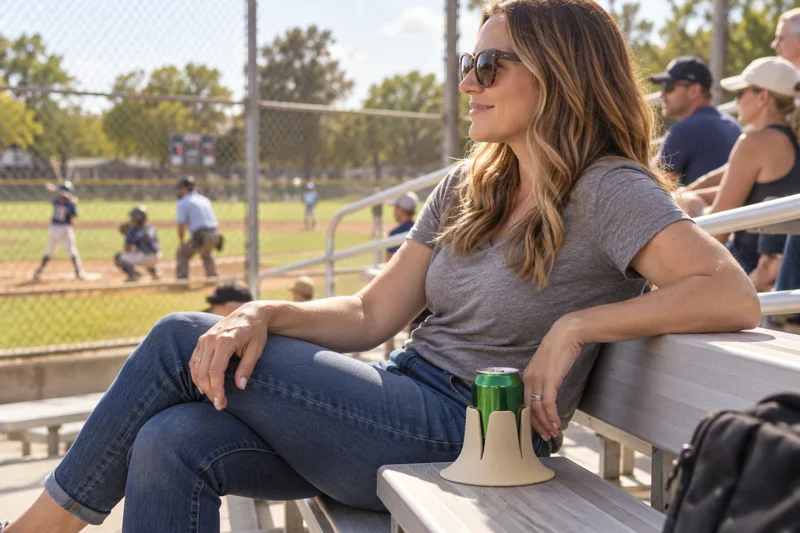
That's what Steadi is: one piece of Shore 85A TPU, 5.2 inches across and 2.8 inches tall, flexible fins that grip the bottom inch of the container. The base is fixed — it doesn't expand, contract, or deform — and that fixed 5.2 inches is the whole mechanism. It widens the base of support underneath the cup, so the drink's center of mass has to travel much further sideways before it clears that base. Tipping takes a far bigger tilt than it would on a bare cup bottom. The tack of the TPU is what resists the sliding, which is the other half of what a smooth plank under a sweating tumbler does to a drink. It sets down on the plank beside your hip, or on the footboard, or on the concrete apron by the fence, and it settles in.

The honest limits, because you have been burned by ads before. It is not a mount, a clamp, a strap or a restraint — a direct hard knock from a sneaker or a standing row still wins, and nothing that isn't bolted to the structure changes that. It does not span a gap in the planking; it needs a plank under it, not a void. It doesn't insulate, so it does nothing about a bench sitting in the sun all afternoon. Handled mugs are an honest no — the handle blocks a fin. And it sinks, so it's the wrong thing to have near open water. It's dishwasher safe, molded in Orange, California, patent pending, and there are 90 days from delivery to decide, returns free, used and rinsed off is fine.

What it fixes is the specific failure this bench creates: a drink that walks on a slick vibrating plank, and a cup with no reason to stay upright when the row moves. Check your own tumbler against the fit check on this site before you buy anything — it takes one sticky note at the kitchen counter tonight, before the gear bag gets packed.

If you actually want the school to fix it

You can, and it's worth knowing the only version of the ask that goes anywhere.

Don't ask for cup holders on the benches — you now know the answer is no, and you know why. Ask about the vertical members the structure already has: the front rail on an elevated bleacher, the guardrail behind the top row, a cross-aisle rail, a press-box rail, the chain-link along the field. Those are exactly the mounts the professional supplier sells — rail, fence, wall, baluster — and the same company says it serves the high school level, not just the pros. A row of rail-mounted holders along a top rail or a fence line is a real, existing, purchasable product, and it doesn't touch the seating or narrow an aisle accessway. It isn't automatically simple — anything hung on a guardrail is a loading question, and CPSC warns specifically that guardrails "not designed to accommodate the loading from people sitting and leaning on them can fail" — but it is a question a facilities department and a manufacturer can actually answer, rather than a request the structure has no answer to.

It still goes through facilities, and it still gets checked against local code, so start with the athletic director and the district's facilities contact rather than a group-chat vote. But it is the version of the request that has somewhere to go.

For everything between the front rail and the top row — which is to say, where you actually sit — the bench is going to keep being a bench. It was engineered to hold up a crowd, not a cup. Six seasons in, you already knew that. Now you know it isn't your imagination, it isn't the district being cheap, and it isn't going to change.

You just don't have to keep putting the coffee on the floor.

Wondering about your specific cup? The fit database has sourced base measurements for 30+ containers — Stanley, Red Bull, Yeti, and the honest no's.

Sources

  1. Spectator Sports Inc. (stadiumcupholders.com) — Stadium cup holders mount only to rails, fences, walls, seat backs or vertical balusters; supplier describes itself as serving 'professional, college and high school levels' and names the Cubs, Dodger
  2. RateYourSeats — Wrigley Field's outfield bleachers are general admission, bench-style seating with no backs; the page lists no cup holders.
  3. Toronto Blue Jays / Newswire.ca — Rogers Centre's nearly $400 million CAD privately funded renovation delivered 'additional legroom, cupholders throughout, modern-shaped seats with more airflow, fewer seats in each row, wider seats an
  4. Blue Jays Nation — Cup holders were added to the Rogers Centre 100 Level during 2024 renovations; the team's announcement to fans read 'You asked for it.'
  5. International Code Council, ICC 300-2017, via UpCodes — ICC 300 bench-seating occupant load is 'one person for each 18 inches of length of the bench' (Sec. 403.1); bleacher seats minimum 9 inches deep with minimum 22-inch row-to-row spacing (Sec. 407.1); a
  6. U.S. Consumer Product Safety Commission, 'Guidelines for Retrofitting Bleachers,' Pub. No. 330 (copy hosted by NC Dept. of Public Instruction) — CPSC bleacher retrofit guidance: 42-inch guardrail height, 4-inch sphere opening limit where surfaces are 30+ inches above ground, rationale that a 4-inch opening stops 95% of children 4 months and ol
  7. U.S. Consumer Product Safety Commission, 'Guidelines for Retrofitting Bleachers,' Pub. No. 330 (full text PDF) — CPSC's Guidelines for Retrofitting Bleachers landing page (canonical publisher location for Pub. No. 330).
  8. King County Directors' Association (KCDA), Bid #22-374 — A public school purchasing co-op bid spec for telescoping gym seats requires center handrails 'not to exceed the front edge of bleacher when stored,' a hinged first aisle step that 'must be stored wit
  9. National Recreation Systems / bleachers.net — Aluminum bleachers run roughly $100 to $500 a seat; VIP seating with armrests can exceed $1,000 a seat; seat planks are 2x10 aluminum in mill finish.
  10. Preferred Seating — Schools choose aluminum bleachers for 'maximum capacity, low cost, and basic functionality'; individual seats with backrests and armrests are significantly more expensive and can be specified with cup
  11. Portland Public Schools Bond Program — School bond packages fund bleachers as capital items - Portland Public Schools' 2020/2025 bond lists 'upgraded bleachers' for a high school baseball and softball field alongside turf, lighting and tra
  12. USPTO / Google Patents, US6354551B1, 'Theater seatback cup holder' (2002) — Background context on why seat-mounted cup holders exist in stadiums and theaters: they facilitate concession sales with a handy non-spill holder, and drinks put down on the floor are too often knocke
Get yours — free shipping

Checkout lives at steadilabs.com, home of the company behind it.