Every order ships free · 30 days to change your mind · Made in Orange, California
The Bleacher Cup Holder.com ← back to the bleacher page

The bleacher file

Why drinks tip on the bleachers — and what actually holds one steady

A bleacher bench was engineered to be a seat, a shared shelf, and a mid-row aisle all at once — holding a drink steady was never in that brief. Here's the physics of why the plank fails a cup differently than a table would, what the pro-stadium retrofit industry does about it, what sports parents already carry to the game, and what a bench actually requires to keep a drink upright through nine innings or four quarters.

One plank, four jobs

An aluminum bleacher bench isn't really furniture in the ordinary sense — it's extruded structural planking, doing at least four jobs at once. Bleacher-industry spec sheets put a standard seat and foot plank at roughly 10 to 12 inches wide, with rows set on about 24-inch centers and an 8-inch rise between them. That single plank is your seat, the row's shared shelf, the mid-row walkway, and — because nothing else exists at hip height — the table for a two-game Saturday's worth of drinks, snacks, a scorebook, and a stranger's blanket, all sharing the same ten inches.

None of that plank was drawn with a drink in mind. It's smooth aluminum, mill-finished or anodized, chosen for cost and weather resistance, not friction. Add a condensation ring off a cold tumbler or a sweating fountain cup and the contact patch between a drink and the plank drops close to zero — there's nothing for a flat, hard cup bottom to grab onto. In direct summer sun, bare bleacher metal has been measured running roughly 140 to 160 degrees Fahrenheit, per National Weather Service–cited guidance, which is why the blanket goes down before you sit — and why nobody expects bare metal to hold a hand flat in July, let alone a cup.

How a bleacher spill actually happens

A spilled drink on a coffee table usually has one cause: somebody bumped it. A bleacher spill has at least three, and all three are built into how a grandstand works.

The first is structural. A grandstand is one continuous connected assembly, so a stomp-the-bleachers chant, a big play, or just a neighbor sliding down to make room travels through the whole plank, not only the spot where it started — an unattended cup on a vibrating bench doesn't just sit there, it walks. The second is behavioral: the whole row stands up at once. The go-ahead run, the fourth-down stop — everybody rises together, and whatever was parked between your feet on the footboard, which doubles as the mid-row walkway every 'excuse me' passes along, meets somebody's foot on the way up. Nobody standing for the play is watching where they left their coffee.

The third is architectural, and it's the one that turns a spill into a total loss. Open bleachers have real gaps between and under the planks, and the space underneath is typically fenced off — a hazard documented enough that CPSC bleacher-safety guidance exists specifically because of what falls through those gaps. A knocked bottle doesn't just spill; it can drop clean through to the dirt under the stands and sit there until someone with a gate key does a walk-through.

Why your bench never got a cup holder

Missing cup holders at the bench level isn't an oversight — it's a budget line that only gets funded at one tier. A specialty retrofit industry exists to bolt cup holders onto stadium seating after the fact: one manufacturer in that space advertises taking orders 'from a couple to 56,000-plus' and lists installs at pro venues including Angel Stadium and Dodgers and Dolphins facilities. That's the real fix, and it works — it's just a facilities purchase, bolted permanently to rails and seat backs a bench bleacher was never built with in the first place. A rec-league field or a school gym doesn't get a line item for that, and even where the budget exists, there's usually no rail at seat-plank height to bolt anything to. You can't bring a stadium's retrofit program to a bench with you.

Wondering about your specific cup? The fit database has sourced base measurements for 30+ containers — Stanley, Red Bull, Yeti, and the honest no's.

What sports parents already try

None of this is a new complaint, and the gear bag already has a few attempted answers — each one runs into the same shape of problem.

The hook-over stadium seat with a side cup sleeve is the default: nearly every veteran travel-ball or football parent owns one. But the sleeve is a shallow mesh pocket sized for a can, not a 40-ounce tumbler, and it's mounted to the one object on the bench that moves the most — the chair frame itself slides on the smooth plank and shifts with every lean of whoever's sitting in it. The holder is attached to the least stable thing in the row.

Clamp-on spring-jaw caddies solve a completely different geometry: they're built to bite a rail, a pole, or a thin tube — a boat's gunwale, a stroller frame, a beach chair's arm. A bleacher plank is a wide, flat box extrusion with no edge at seat height for a jaw to grab, so the clamp has nowhere to attach where you're actually sitting.

The cardboard four-cup concession tray survives exactly one trip — the walk back from the snack shack — then sits gripless on a smooth, vibrating plank, goes soft under its own condensation, and gives out the first time someone slides down the row to make room. It was built to carry drinks, not to hold them still. And the cup holders that do exist, on the wagon and the camp chairs, are staged at ground level by the fence: useful for loading in before first pitch, and out of reach once you've climbed the steps.

What a bench actually needs

Every fix above shares the same mistake: it tries to attach to something — a rail, a chair frame, a cardboard flap — on a surface that offers none of those things at seat height. A bleacher plank has no edge to clamp and no slot to drop into. What it has is a wide, flat, smooth surface that moves.

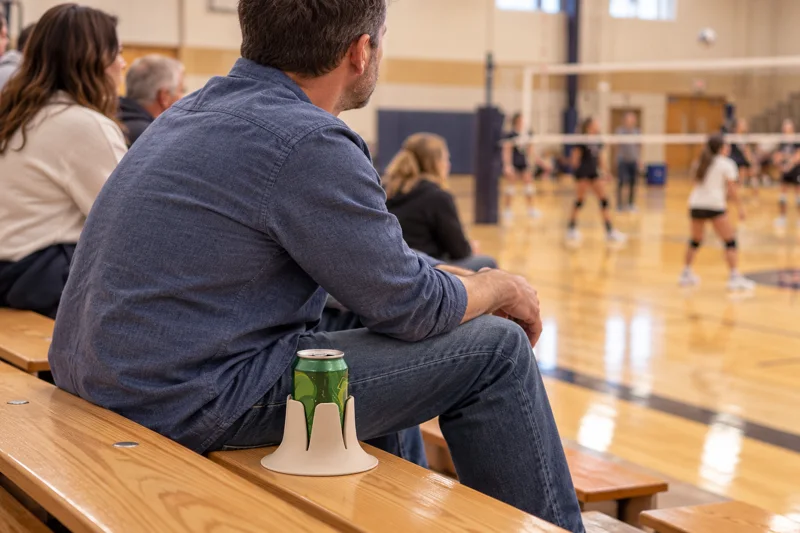
That points to the only shape of answer that actually fits the surface: something that doesn't attach to anything, because it brings its own footprint and its own grip instead. A wide base lowers the leverage a tall drink has against a bump — a narrow-bottomed tumbler on a smooth plank is a lever waiting for a nudge, and a wider contact patch resists that tip rather than amplifying it. Flexible fins hold the container by its bottom inch, gripping from the sides instead of clamping to the bench, so a stomping grandstand or a scooting neighbor moves the plank without walking the drink loose. A base between 2 and 3 inches across settles in fully, and the fins flex enough to seat a snug 3.15-inch base too — which covers the range this crowd actually carries, since Stanley's own Quencher line alone spans 14 to 64 ounces. And because nothing here bolts down, a jostle doesn't end in a fall: the base settles the drink back toward level instead of letting a knock become the start of a roll toward the gap.

That's the real difference between a bleacher bench and a table: the bench was never going to grow a cup holder on its own, so the answer has to travel with you — up the steps, onto the plank, and back down at the last out.

Get yours — free shipping

Checkout lives at steadilabs.com, home of the company behind it.